Policy Reports
Karen Yeung has worked on a range of policy initiatives in the UK, EU and globally, both producing policy reports and studies and participating in consultations and working groups.

Securing Meaningful Fundamental Rights Protection: Towards a Truly New Approach to European Technical Standards for Data Informed Applications and Services
Policy Brief and Public Engagement Report
This policy brief examines the legitimacy and effectiveness of the EU‘s ‘New Approach’ to technical standardisation, focusing on software-based applications and services that are informed by the analysis of data that affect individuals, groups, societal rights and interests (which we call ‘data informed applications and services’). Our analysis draws on selected insights from regulatory governance scholarship and our own direct experience ‘in the field’ as representatives of Equinet in ongoing technical standards development currently taking place under the auspices of the CEN/CENELEC JTC21 work programme to establish harmonised European standards pursuant to the EU’s AI Act.1 It is primarily addressed to policymakers and stakeholders (government, industry and third sector) with an interest in the regulation and governance of digital services.

AI and Public Standards: 2024 AI seminar summary note
A summary note of the Committee's 21 March 2024 AI seminar.
In 2020, the Committee on Standards in Public Life published its report, Artificial Intelligence and Public Standards, looking at whether the then regulatory and governance framework for AI was sufficient to ensure that public standards would continue to be upheld as AI is adopted more widely across the public sector. Four years on and given the pace of AI developments since then, the Committee held a seminar on 21 March 2024 to revisit some of the issues raised in that report, specifically the assurances required to enable public office holders to be comfortably accountable for advice and decisions derived from or made by AI in which Karen Yeung was an expert participant. A summary note of that discussion is available at the following link. The note does not attribute comments or views to any particular individual or organisation.
Royal Academy of Engineering
Technology Pathways and Meaningful Innovation programme
This programme aims to stimulate and contribute to debates and actions that will help to better align the role of technologies, the groups that shape them and the people that use them. Through iterative dialogue between a range of stakeholders about emerging technologies and their potential social impacts, it will seek to generate meaningful insights for those who create the pathways for technology change. In so doing, it seeks to promote greater inclusivity in the creation of those pathways, with the aim of enabling better socio-technical innovation, and better outcomes: meaningful and practical steps towards a just transition to net zero, an inclusive economy and sustainable society. Karen Yeung is a member of the steering group for this programme, established in 2023.

EU Scientific Advice Mechanism
Successful and timely uptake of artificial intelligence in science in the EU (April 2024)
In July 2023, the College of Commissioners asked the Scientific Advisory Panel of the European Commission to provide evidence-based advice on how to accelerate the responsible update of AI in science. To address this question, SAPEA, as a consortium of scientific academy networks representing a large number of academies from different countries, assembled an independent, international and interdisciplinary working group of leading experts in the field, nominated and selected from European academies and their networks.
Karen Yeung was a member of this group. Between October 2023 and January 2024, it reviewed and compiled the latest evidence on the subject, to create an evidence review report. This report informs the accompanying Scientific Opinion of the Group of Chief Scientific Advisors, including requested policy recocomendations.
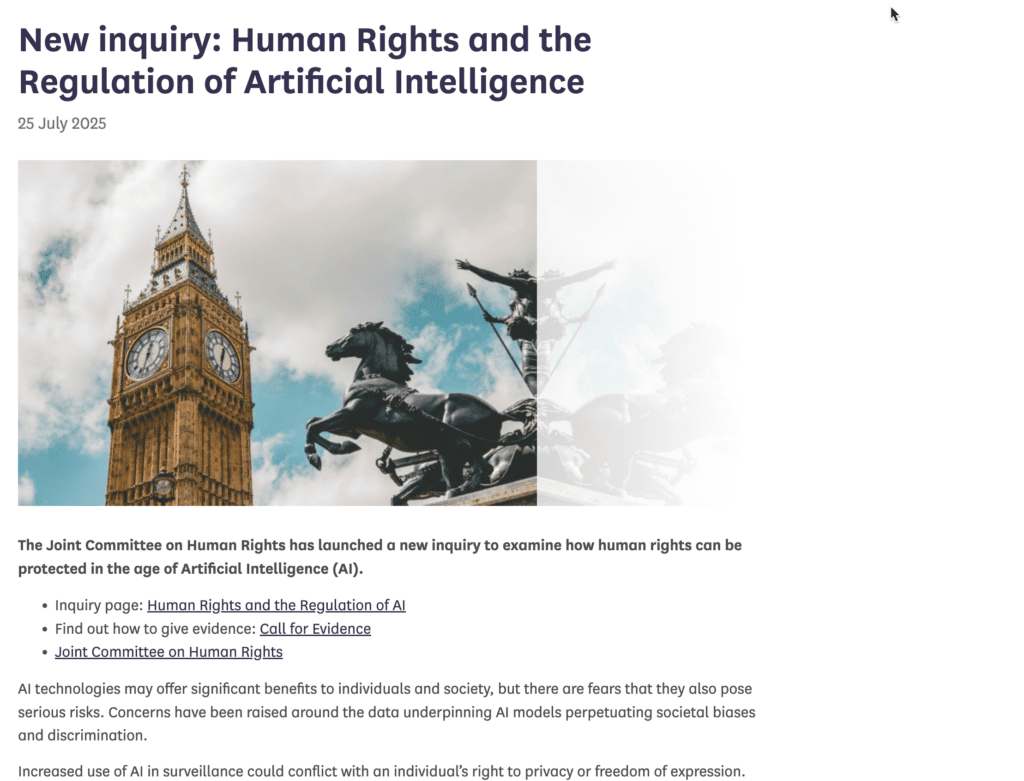
“Joint Committee on Human Rights, New inquiry: Human Rights and the Regulation of Artificial Intelligence (2025-2026)
The Joint Committee on Human Rights has launched a new inquiry to examine how human rights can be protected in the age of Artificial Intelligence (AI).
The Joint Committee on Human Rights launched an inquiry in July 2025 to examine how human rights can be protected in the age of Artificial Intelligence (AI). It will examine the threats and opportunities AI offers for human rights in the UK. It will also consider whether existing legal and regulatory frameworks in the UK are sufficient to protect human rights and keep pace with AI development. The Inquiry will focus in particular on rights to privacy, rights to equality and non-discrimination, and the right to an effective remedy for human rights violations. Karen Yeung was appointed as Special Advisor to the Committee in December 2025 to support its inquiry.

EU High Level Expert Group on Artificial Intelligence (AI HLEG)
As one of the two UK-based members of this Group, Karen contributed to the negotiation and drafting of the EU’s Ethics Guidelines for Trustworthy AI.
June 2018 - July 2021
This role entailed intensive involvement in the EU’s European initiative on AI by formulating and drafting the Commission AI ethics guidelines for which she was a Rapporteur, formulating and proposing investment and policy recommendations to address AI-related mid to long-term challenges, published as:

Council of Europe, Committee of Experts on human rights dimensions of automated data processing and different forms of artificial intelligence (MSI-AUT), Independent Expert Member and Rapporteur
January 2018 - June 2020
As a member of the Committee, Karen Yeung has played a key role in drafting its outputs:
- Council of Europe, Rapporteur - Karen Yeung, A study of the implications of advanced digital technologies (including AI systems) for the concept of responsibility within a human rights framework.
- See https://www.coe.int/en/web/freedom-expression/msi-aut. Adopted by the Council in October 2019.
- Also available’ https://papers.ssrn.com/sol3/papers.cfm?abstract_id=3286027
- Declaration by the Committee of Ministers on the manipulative capabilities of algorithmic processes adopted by the Council on 13.2.2018.
- Recommendation of the Committee of Ministers to member States on the human rights impacts of algorithmic systems. Establishes a set of horizontal set of guidelines, directed at States, public and private sector actors, aimed at promoting an environment of legal certainty in which both human rights and innovation can thrive. Building on existing Council of Europe standards related to the protection of human rights in contemporary societies, the guidelines cover multiple aspects of algorithmic systems including data management, modelling and analysis, transparency, accountability and effective remedies, precautionary measures and research, innovation and public awareness. Adoption by the Council on 8 April 2020.

Nuffield Council of Bioethics, Working Party on Genome Editing and Human Reproduction
September 2016 – July 2018
Karen Yeung, as Chair of this working party, led the inquiry’s examination of ethical questions relating to the attempted influence of inherited characteristics in humans, in the light of the likely impact of genome editing technologies on human reproduction. Its report, ‘Genome editing and human reproduction: social and ethical issues’ was published on 17 July 2018.
As Chair, Karen Yeung was primary spokesperson for the Report at the time of its publication across media and at public events.

Topol Independent Technology Review for the NHS, Ethics Expert, Digital Medicine Panel
March 2018 - March 2019
This Review advised the Secretary of State for Health on how technological and other developments (including in genomics, pharmaceutical advances, artificial intelligence, digital and robotics) are likely to change the roles of clinical staff in all professions over the next two decades.

Royal Society and British Academy, Working Group on Data Governance
August 2016 – June 2017
This working group, co-chaired by Dame Ottoline Leyser and Prof Genevra Richardson, brought together lawyers, philosophers, historians, social scientists and computer scientists to better understand the key social and ethical aspects of data governance and how they are related. Its report, Data Management and use: governance in the 21st century identifies a governance framework for data that is intended to engender authority and trust (issued June 2017).

Nuffield Council of Bioethics, Working Group on Genome Editing
July 2015 - Aug 2016
To explore ethical issues around new genome editing techniques which scientists regard as particularly promising due to their relative efficiency, low cost and ease of use, prompting their rapid and broad uptake. These techniques can be applied to all genomes (microbes, plants, insects, animals and humans) and thus offer a potentially unlimited range of applications.

UKRI Trustworthy Autonomous Systems Programme Advisory Board
from September 2019 - ongoing
UKRI is the UK government body that directs research and innovation funding, bringing together the seven existing UK research councils, and Innovate UK and the Research and Knowledge Exchange functions of the Higher Education Funding Council for England (HEFCE), into one unified body.
European Research Council, Ethics Expert
from May 2019
Karen Yeung has been an ethics expert for the ERC since May 2019, undertaking reviews and providing the ERC with advice on ethics dimensions of ERC research proposals.