
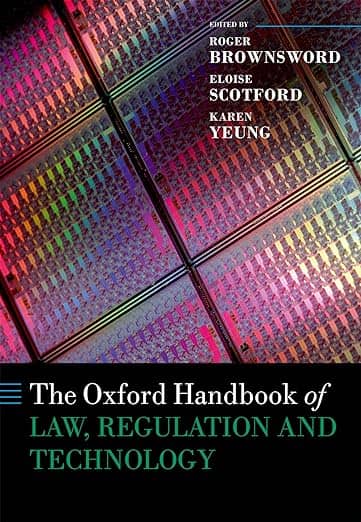
The Oxford Handbook of Law, Regulation & Technology (eds) 2016
Original Perspectives on Technological Development and the Law’s Response
“…the Handbook certainly examines its subject matter from several multi-disciplinary viewpoints ranging from psychology and sociology to philosophy, jurisprudence and more.”
―Phillip Taylor MBE
Buy From...
Synopsis
The variety, pace, and power of technological innovations that have emerged in the 21st Century have been breathtaking. These technological developments, which include advances in networked information and communications, biotechnology, neurotechnology, nanotechnology, robotics, and environmental engineering technology, have raised a number of vital and complex questions. Although these technologies have the potential to generate positive transformation and help address ‘grand societal challenges’, the novelty associated with technological innovation has also been accompanied by anxieties about their risks and destabilizing effects. Is there a potential harm to human health or the environment?
What are the ethical implications? Do these innovations erode or antagonize values such as human dignity, privacy, democracy, or other norms underpinning existing bodies of law and regulation?
These technological developments have spawned a nascent but growing body of ‘law and technology’ scholarship, broadly concerned with exploring the legal, social and ethical dimensions of technological innovation.
This handbook collates the many and varied strands of this scholarship, focusing broadly across a range of new and emerging technology and a vast array of social and policy sectors, through which leading scholars in the field interrogate the interfaces between law, emerging technology, and regulation. Structured in five parts, the handbook (I) establishes the collection of essays within existing scholarship concerned with law and technology as well as regulatory governance; (II) explores the relationship between technology development by focusing on core concepts and values which technological developments implicate; (III) studies the challenges for law in responding to the emergence of new technologies, examining how legal norms, doctrine and institutions have been shaped, challenged and destabilized by technology, and even how technologies have been shaped by legal regimes; (IV) provides a critical exploration of the implications of technological innovation, examining the ways in which technological innovation has generated challenges for regulators in the governance of technological development, and the implications of employing new technologies as an instrument of regulatory governance; (V) explores various interfaces between law, regulatory governance, and new technologies across a range of key social domains.
Book Review
Phillip Taylor MBE
As the dizzying pace of technological change accelerates, can the law keep up? Obviously, there is no one answer to such a question if there can be any unequivocal answer at all. Yet within this wide ranging and complex area of enquiry, a multiplicity of issues emerges and as the debate continues, this new Handbook from the Oxford University Press will no doubt make a valuable contribution. In showcasing leading research in an emerging field, this Handbook offers a number of original perspectives — as well as warnings — in which sociological and moral, as well as technical and legal issues are carefully considered. This is an important publication which everyone interested in this subject should acquire.
