
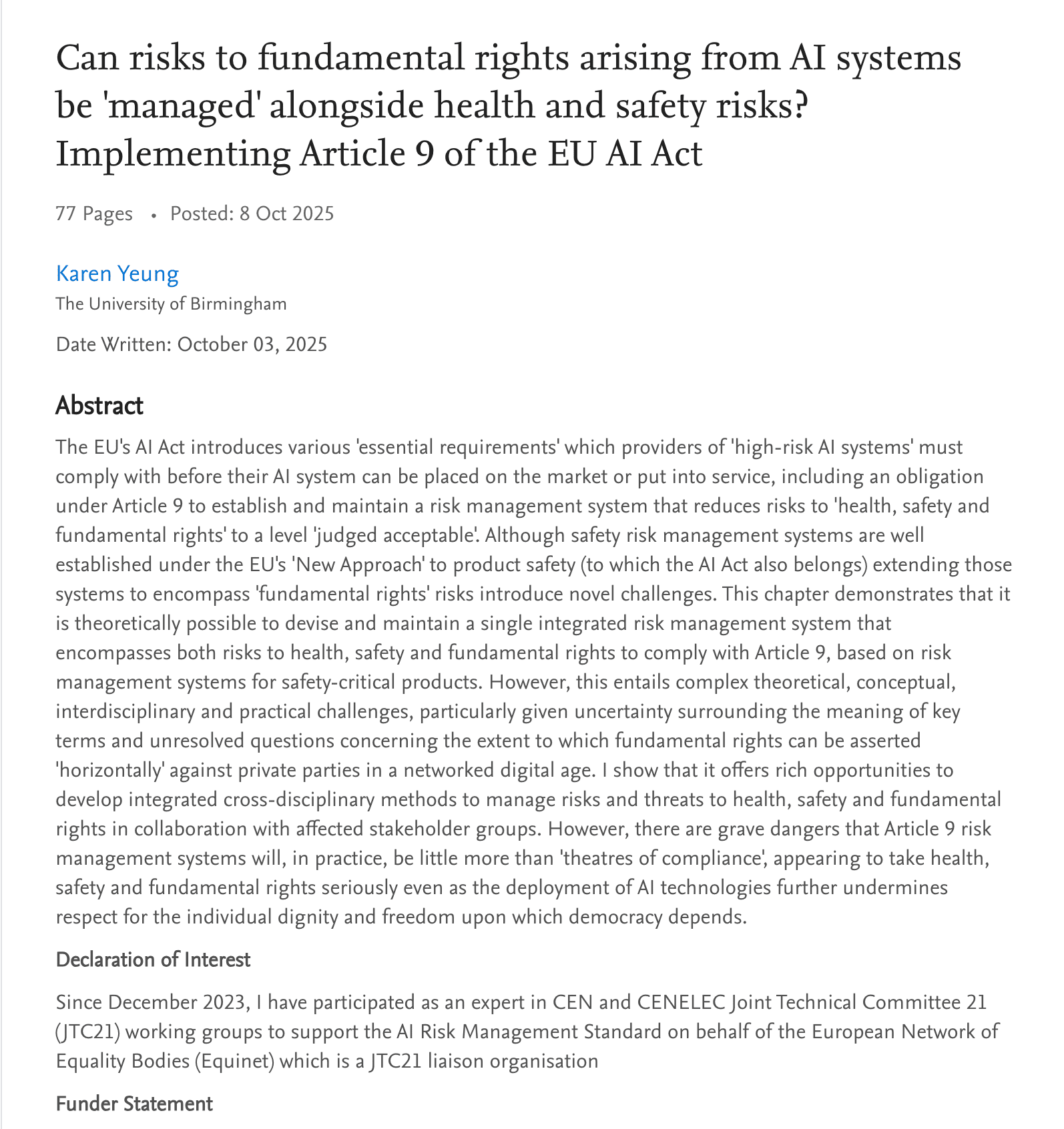
This paper examines whether the risks to fundamental rights posed by AI systems can be effectively ‘managed’ along with health and safety risks.
With the EU’s AI Act provisions to govern ‘high-risk’ AI systems shortly entering into force, high-risk AI providers will be obliged to establish and maintain a ‘risk management system’ which reduces risks to ‘health, safety and fundamental rights’ to a level ‘judged acceptable’.
But what does this mean? And how can these obligations be operationalised on the ground?
Although safety risk management systems are well-established to manage the risks of safety-critical products, fundamental rights establish moral boundary makers to safeguard respect for the dignity of each and every person.
I show that it is theoretically possible to devise and maintain a single integrated risk management system that encompasses both risks to health, safety and fundamental rights to comply with Article 9. But this is a complex exercise. While Article 9 is rich with opportunities to develop integrated cross-disciplinary methods to manage risks and threats to health, safety and fundamental rights in collaboration with affected stakeholder groups, I argue that there are real dangers that Article 9 compliance will be merely performative: appearing to take health, safety and fundamental rights seriously even as the deployment of AI technologies further undermines respect for the individual dignity and freedom upon which democracy depends.